Picture this: You’re cozy on the couch, phone in hand, mindlessly doomscrolling. Suddenly, your device vibrates – it’s a message warning your bank account was compromised. But wait! It’s just your cousin’s dog’s Instagram page again. If this sounds like your typical Thursday, you’re not alone. In our hyperconnected (read: slightly paranoid) world, mobile app security is more vital—and more bizarre—than ever. Let’s dive into the fun, foggy future of keeping your phone safe from evil algorithms, sneaky hackers, and even your own forgetfulness.
Meet the New Villains: Threats on the 2025 Horizon (Without the Capes)
Forget the capes and dramatic theme music—2025’s mobile app security threats are all about brains, not brawn. The new villains are clever, sneaky, and powered by AI. They don’t need to leap tall buildings; they just need to leap past your device’s defenses while you’re distracted by cat videos. Let’s unmask the biggest Mobile App Security Threats coming your way, and why you’ll need more than a strong password to keep up.
AI-Driven Phishing: Your Mom, Boss, and Pizza Chain—All in One
Remember when phishing emails were easy to spot? (Looking at you, “Dear Sir/Madam, click here for your inheritance.”) Those days are over. AI Attacks and Threats are now so advanced, they can mimic your mom’s texting style, your boss’s urgent requests, or even your favorite pizza chain’s cheesy deals—with unsettling precision. By 2025, experts predict AI-driven phishing attacks will make up 60% of all social engineering attempts. As Lisa Hsu, Mobile Security Analyst, warns:
“The next wave of cyberattacks will outsmart humans, not just machines.”
So, if your phone buzzes with a message about “urgent pizza delivery issues,” double-check before you hand over your login info—or your lunch.
Mishing & Sideloaded Apps: The Lunch-Break Bandits
While you’re busy picking the perfect emoji, mishing (SMS phishing) and sideloaded rogue apps are plotting their next big heist. Mishing attacks use text messages to lure you into clicking malicious links, while sideloaded apps sneak onto your device from outside official app stores. Both are on the rise as mobile-first attacks become more frequent and sophisticated.
- Mishing: Expect more SMS scams that look like they’re from your bank, your delivery service, or even your gym (because who wouldn’t trust a text about free protein shakes?).
- Sideloaded Apps: These apps bypass official checks, bringing malware and spyware straight to your home screen. If you’re tempted by “exclusive” apps not found in the app store, think twice—your data could be the real prize.
Compliance: When Your Phone Needs a Detective Badge
It’s not just hackers you need to worry about—regulators are stepping up, too. In finance and healthcare, new compliance rules (like PCI) now require device integrity and root detection. That means your app must know if your device has been tampered with, rooted, or otherwise compromised. By 2025, even everyday users will need to pass security checks worthy of a spy movie just to access their accounts.
- Device Integrity: Apps must verify your device hasn’t been jailbroken or rooted, especially in sensitive industries.
- Root Detection: If your device fails the test, access is denied—no matter how convincing your disguise (or your password).
Mobile App Security Trends 2025: Who’s Leading the Attack?
Here’s a quick look at the anticipated breakdown of Mobile App Security Threats in 2025:

Stay alert—these villains may not wear capes, but they’re definitely dressing up as someone (or something) you trust.
The Good, The Bad, and the Tech: (Un)Common Defenses You Didn’t Know You Needed
Let’s face it: mobile app security isn’t just about locking the front door anymore—it’s about installing a moat, hiring a dragon, and maybe even making your apps do a little yoga for flexibility. Welcome to the wild world of Best Practices Mobile Application Security, where yesterday’s “nice-to-have” is today’s “must-have-or-else.”
Multi-Factor Authentication & Biometrics: Your New Daily Workout
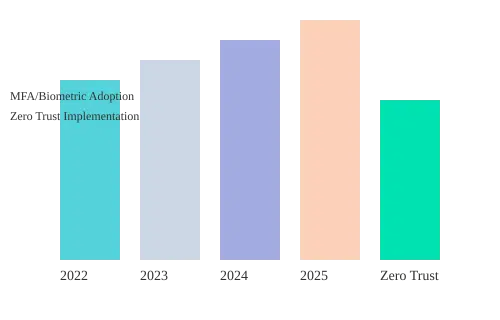
Remember when logging in meant just a password? Those were the days. Now, Multi-factor Authentication (MFA) and fingerprint scans are your new morning stretches. By 2025, over 85% of major apps will require you to prove you’re not a robot, a cat, or your mischievous little brother. Why? Because MFA and biometrics like Face ID and fingerprint scans are the protein shakes of mobile security—making it much harder for hackers to sneak in through the digital back door.
- MFA: Something you know (password), something you have (phone), something you are (fingerprint). Triple threat!
- Biometrics: Your thumbprint is now more valuable than your autograph.
Zero Trust Security Model: Trust No One (Not Even Your Phone)
If you think your phone is your friend, think again. The Zero Trust Security Model treats every device, network, and user like that mysterious leftover in the office fridge: trust no one, ever. This isn’t paranoia—it’s the new normal. Between 2022 and 2025, Zero Trust adoption in mobile security has jumped by 40%. Constant verification is the name of the game, and it’s making lazy hackers cry into their keyboards.
- Every access request is checked, double-checked, and then checked again.
- Assume breach, act accordingly, and you’ll sleep better at night (promise).
“Trust is a vulnerability. Assume breach, and you’ll sleep better.” – Rafael Gardner, Security Strategist
Encryption: Because Your WiFi Loves to Gossip
Think encrypted data is just for spies? Think again. Encryption of Sensitive Data—both in transit and at rest—is now a core defense. It’s less about James Bond and more about not letting your WiFi spill your secrets at the coffee shop. Non-encrypted apps face a 50% higher risk of breaches, so encrypting everything is the digital equivalent of duct-taping your diary shut.
- Encrypt data in transit: So your info isn’t eavesdropped on as it travels.
- Encrypt data at rest: So if someone finds your phone, they can’t read your secrets.
Mobile Security Predictions 2025: Advanced Defenses Go Mainstream
By 2025, expect advanced defenses like MFA, biometrics, Zero Trust, and encryption to be as common as cat videos. These aren’t just trends—they’re the new baseline for Best Practices Mobile Application Security. Developers, businesses, and users alike need to flex these security muscles to stay ahead of the ever-evolving threats.

DIY for the Paranoid: Actionable Steps & Oddball Best Practices (You’ll Thank Me Later)
Regular Security Checkups: Like Flossing, Annoying but Seriously Effective
Let’s be honest: nobody enjoys security audits. But skipping them is like refusing to floss and then wondering why your teeth fall out. For mobile app developers, regular security checkups are the first line of defense. Don’t wait for a hacker to point out your app’s cavities—schedule routine penetration testing. Why? Because up to 80% of critical flaws are caught during these tests. That’s not just a number; that’s your app’s reputation on the line.
API Protection, Code Obfuscation, and Penetration Testing: Three Ingredients for Hacker Heartburn
If you want actionable insights app developers can actually use, start with your APIs. In 2023, 90% of successful breaches exploited API vulnerabilities. That’s not a typo. API security is now the main course on every hacker’s menu. Here’s your recipe for making their lives miserable:
- API Security: Use authentication, rate limiting, and strict input validation. Don’t let your endpoints become an all-you-can-eat buffet for attackers.
- Code Protection Techniques: Obfuscate your code. Make it look like spaghetti written by a caffeinated octopus. The harder it is to reverse-engineer, the safer you are.
- Penetration Testing: Simulate attacks with tools and real humans. Remember, “set it and forget it” is for rotisserie chickens, not app security.
| Security Threat | Impact |
|---|---|
| API Vulnerabilities | 90% of breaches in 2023 |
| Critical Flaws Found via Pen Testing | Up to 80% of audited apps |
Device Attestation: Your Phone Should Prove It’s Not a Supervillain in Disguise
Welcome to the age of device integrity mandates. If your app handles anything remotely sensitive (think banking, healthcare, or top-secret cat memes), your users’ devices need to prove they’re not compromised. Device attestation and root detection are your new best friends. They help ensure your app isn’t running on a jailbroken phone or a device that’s been tampered with by, say, a bored teenager with too much time and a penchant for chaos.
Dynamic Security Models: Don’t Leave Your Security to Fate (or Teenagers)
Static security is so last decade. Today, you need dynamic security models that adapt to new threats. Frequent audits, tough APIs, and smart code defenses are the new normal. Don’t rely on luck—rely on layers. Your users (and your future self) will thank you.
“Your mobile app’s biggest weakness is often just a forgotten line of code.” – Priya Banerjee, App Security Consultant
So, whether you’re a developer, a business owner, or just a privacy-obsessed power user, remember: paranoia isn’t just healthy—it’s essential.

The Human Factor: Educating Users and Outwitting the Machines (and Ourselves)
Let’s face it: when it comes to mobile app security, the weakest link is often the one holding the phone. Yes, that’s you, me, and everyone who’s ever clicked “Remind Me Later” on a security update. User Awareness in Security isn’t just a buzzword—it’s the secret sauce that keeps our data safe from Mobile-first Attacks, phishing schemes, and the ever-creative world of social engineering. And yet, most of us are more likely to read a meme than a security warning.
Consider this: 80% of mobile breaches are caused by user error or social engineering. That’s right—hackers aren’t always breaking through firewalls; sometimes, they’re just tricking you into handing over the keys. Meanwhile, less than 20% of users enable all available security settings on their mobile devices. If security were a group project, we’d all be that one student who forgot to do their part.
| Statistic | Value |
|---|---|
| Mobile breaches due to user error or social engineering | 80% |
| Users enabling all security settings | <20% |
So, what’s the fix? User awareness campaigns—preferably with a healthy dose of humor and memes—are a must. As Samantha Chen, User Experience & Security Advocate, puts it:
‘Train your users like you train your pets—reward and repetition go a long way.’
But education alone isn’t enough. Enter Dynamic Security Policies: the digital equivalent of a security guard who never sleeps and updates their tactics in real time. These models let apps adapt to new threats instantly, without waiting for users to download an update they’ll probably ignore. Imagine if our memories worked like that—no more forgetting passwords or falling for the same old phishing and social engineering tricks.
And don’t forget Biometric Authentication. Fingerprints and face scans are making it harder for attackers to impersonate you, even if you’re a little too generous with your password-sharing habits. Still, as long as humans are involved, there’s always a wild card. Picture this: your future fridge pings you about a suspicious login attempt on your toaster oven’s app. Sounds absurd? Maybe not for long. As the Internet of Things grows, every device becomes a potential security touchpoint—and another opportunity for user error.
In the end, humans remain both the greatest risk and the greatest asset in mobile app security. Teaching users to stay vigilant is just as important as building firewalls and rolling out the latest encryption. The future of mobile app protection will be a blend of smart technology and smarter people—because outwitting the machines (and ourselves) is a team sport. So, next time you see a security prompt, don’t swipe it away. Your fridge—and your data—will thank you.
TL;DR: Mobile app security is evolving at warp speed. Expect smarter attacks, cleverer defenses, and lots more responsibility for anyone with a smartphone (so… all of us). The good news? Knowing a few tricks and trends will keep your apps—and sanity—relatively intact.