
Let’s face it: the robots are (probably) not coming to steal your job tomorrow, but AI is definitely shaking up the old workplace routine. I once tried explaining to my grandmother what a chatbot does—she thought it was some sort of tea-making robot. If you don’t want your career advice to come from confused relatives, stick around. This post is your map to surviving (and actually thriving) in the wild world of AI-powered work. Spoiler: You won’t need to move to Silicon Valley, wear a hoodie at all times, or replace your face with an emoji. (Unless you want to, of course.)
AI Skills for 2025: Shiny Buzzwords or Survival Essentials?
Let’s face it: if you’re reading this, you’re probably wondering if “generative AI skills” are the new avocado toast—trendy, expensive, and possibly a little overhyped. Or are they the bread-and-butter survival essentials you’ll need to avoid being replaced by a robot with a better LinkedIn profile? Spoiler: It’s not hype. It’s your future. And, yes, robots are coming for your job—unless you beat them to it by upskilling.
The Real (and Rising) Demand for AI Skills in 2025
Remember when “AI” was just a sci-fi movie plot? Well, research shows that in 2025, AI skills in demand are as real as your morning coffee addiction. There are now over 80,000 job postings mentioning generative AI—up from a measly 3,780 in 2010. That’s not just a trend; that’s a full-blown stampede. If you’re still brushing up on your 2010 Excel macros, it’s time to pivot.
| Year | AI-Related Job Postings | Salary Premium |
|---|---|---|
| 2010 | 3,780 | – |
| 2025 | 80,000 | +28% |
And if you’re thinking, “Sure, but I’m not a programmer,” here’s the plot twist: AI job market trends show that everyone wants a slice of the AI pie. Marketing, HR, consulting, management—you name it, they’re all hiring for essential AI skills. It’s not just about coding anymore; it’s about knowing how to use AI to outsmart your competitors (and maybe your boss, but don’t quote me on that).
Surprising Industries: It’s Not Just for Techies Anymore
If you thought AI was only for hoodie-wearing developers in Silicon Valley, think again. Studies indicate that AI has officially crashed the party in industries you’d never expect. Marketing teams are using generative AI to craft irresistible campaigns. HR is deploying AI to spot talent (and, let’s be honest, weed out the serial resume embellishers). Even consulting firms are hiring AI-savvy folks to help clients future-proof their businesses.
- Marketing: AI-powered content creation, customer insights, campaign optimization
- HR: Automated recruiting, employee engagement analysis, predictive attrition
- Consulting: AI strategy, digital transformation, risk assessment
- Management: Data-driven decision-making, workflow automation, forecasting
The bottom line? If you can combine AI skills with industry know-how, you’re basically the unicorn everyone’s hunting for. And unicorns, as we know, get paid well—28% higher salaries on average, according to the latest data. Move over, artisanal bread-baking side hustle!
Hybrid Skills: Why Soft Skills Matter in a Robotic World
Here’s where things get interesting. You might think AI jobs are all about algorithms and machine learning models, but employers are actually craving something even robots can’t fake (yet): soft skills. Communication, creativity, leadership, and problem-solving are essential AI skills for 2025.
Why? Because, as Andrew Ng wisely put it:
“The future job market isn’t about man versus machine—it’s about collaboration.”
Translation: The best jobs will go to people who can work with AI, not just build it. You’ll need to explain complex AI results to your boss (who still thinks “the cloud” is weather-related), brainstorm creative solutions, and lead teams through tech-driven change. If you can blend human judgment with AI-powered insights, you’re not just future-proof—you’re future-fabulous.
Chart: AI Job Postings—2010 vs. 2025

So, whether you’re a marketer, manager, or master of memes, the message is clear: AI skills for 2025 aren’t just shiny buzzwords—they’re your ticket to surviving (and thriving) in the robot apocalypse. Time to upskill, outsmart, and maybe even out-dance the machines.
How to Upskill Without Losing Your Sanity (or Wallet)
Let’s face it: the robots aren’t coming for your job—they’re already here, and they’re eyeing your ergonomic chair. But before you spiral into existential dread (or start prepping your résumé for a career in interpretive dance), let’s talk about upskilling for AI without torching your savings or your last nerve. Because, as research shows, the future belongs to those who can juggle both algorithms and actual life—preferably without dropping either on their foot.
Practical Ways to Learn AI Skills on a Shoestring Budget
First things first: you don’t need a Silicon Valley zip code or a trust fund to get started with AI upskilling programs. In fact, you can begin learning AI skills with nothing but Wi-Fi, curiosity, and maybe a strong cup of coffee. Here’s your not-so-secret starter pack:
- YouTube University: Yes, the same place you learned to fix your leaky faucet is also overflowing with free AI tutorials. No tuition, no judgment, just algorithms and the occasional cat video.
- MOOCs (Massive Open Online Courses): Platforms like Coursera, edX, and Udemy offer beginner-to-advanced AI workforce development courses. Many are free, or at least cheaper than your monthly coffee habit.
- Local Workshops & Meetups: Check your community center or library. Sometimes, the best upskilling strategies are hiding in plain sight, sandwiched between “Intro to Knitting” and “Advanced PowerPoint Karaoke.”
- Internal Company Programs: If you’re lucky enough to work somewhere that’s not run by actual robots, ask HR about in-house AI upskilling programs. Many companies are now investing in enterprise-wide AI literacy—because, let’s be honest, nobody wants to be the office dinosaur.
The best part? You don’t need to be a math prodigy or a code whisperer. AI fluency is quickly becoming as important as knowing how to use spreadsheets (and let’s be real, you survived learning VLOOKUP, so you’ve got this).
Wild Card: Imaginary Upskilling Olympics
Picture this: The Upskilling Olympics. In Lane 1, we have the night-school nurse, juggling patient charts and Python scripts. In Lane 2, the artist-turned-data-wrangler, painting with pixels and pivot tables. And, in Lane 3, your skeptical cousin Joe, who still thinks “AI” stands for “Absolutely Impossible.”
- The Nurse: Masters bedside manner and machine learning, proving that empathy and algorithms are the ultimate power couple.
- The Artist: Brings creativity to code, making AI models that are as beautiful as they are functional. (Also, probably has the coolest LinkedIn profile picture.)
- Cousin Joe: Reluctantly signs up for a free online course, discovers AI isn’t just for “tech people,” and becomes the family’s go-to chatbot whisperer.
Who wins? Trick question. In the age of hybrid roles, everyone who blends technical know-how with human creativity gets a medal (and maybe a raise). Studies indicate that AI plus human judgment is, frankly, unstoppable. Sorry, Joe.
Balancing Continuous Learning With, You Know, Having a Life
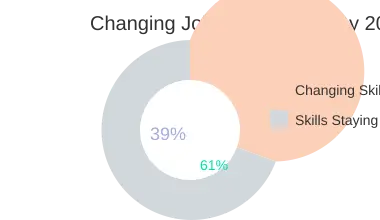
Let’s be honest: Continuous learning sounds exhausting. But with 39% of all job market skills predicted to change by 2030 (see the donut chart below for a visual snack), standing still is basically moving backward in slow motion. The good news? You don’t have to quit your day job, abandon your hobbies, or give up on sleep.
- Set micro-goals (think: “Watch one AI tutorial per week,” not “Become the next Fei-Fei Li by Friday”).
- Mix and match learning formats—podcasts on your commute, quick quizzes during lunch, and maybe a little late-night coding instead of doomscrolling.
- Remember:
“Reskilling for tomorrow’s jobs doesn’t mean forgetting today’s strengths—combine, don’t discard.” – Fei-Fei Li
Hybrid roles reward those who blend technical AI with creative problem-solving. Lifelong learning, resilience, and agility are the new power skills. And if you’re worried about falling behind, just remember: even the robots are still learning.
The Human Touch: Outrunning the Robots with Soft Skills
Let’s be honest: if you’re reading this, you’re probably wondering if your job will soon be snatched by a robot with a suspiciously chipper voice and zero appreciation for dad jokes. Good news! While AI is gobbling up repetitive tasks faster than you can say “automation,” there’s one thing it still can’t do: be you. And trust me, that’s a superpower—especially if you’ve got a killer sense of humor or the uncanny ability to comfort a coworker after the printer jams for the third time this week.
Sure, AI can crunch numbers, spot patterns, and even write poetry (badly). But when it comes to the real power moves—empathy, judgment, and, yes, the art of the perfectly timed pun—AI is still playing catch-up. Research shows that the future of work isn’t about outrunning the robots, but outrunning the parts of yourself that could be replaced by a glorified spreadsheet. The secret sauce? Blending AI literacy with those irreplaceable human skills.
Why AI Can’t Match Your Sense of Humor (Yet)
Let’s face it: AI is about as funny as a tax audit. Sure, it can tell you a knock-knock joke, but will it ever understand why your “lettuce in” punchline is comedic gold? Not likely. The real power of AI and human skills lies in the blend—think of it as peanut butter and jelly, but with less stickiness and more job security. As companies scramble to adapt to technology, they’re realizing that AI can’t handle nuance, sarcasm, or the subtle art of reading a room. (Or, for that matter, reading your boss’s mood after their third coffee.)
Studies indicate that AI-enriched jobs value critical thinking and flexibility—two things robots are still struggling with. So, while you’re learning to wrangle a chatbot, don’t forget to flex those soft skills. They’re your best defense against the robot apocalypse (and awkward Zoom calls).
Storytime: That Time an Algorithm Rejected My Pun-Laden Resume
True story: I once submitted a resume so full of puns, the algorithm screening it probably short-circuited. “Expert in Java (the coffee and the code),” I wrote. “Pro at debugging (both software and awkward conversations).” The result? A polite, automated “no thanks.” Turns out, AI hasn’t developed a taste for wordplay—yet. But guess what? The hiring manager called me anyway, just to say my cover letter made her laugh. That’s the magic of human connection. In the future, the best jobs will go to folks who can both comfort a coworker and wrangle a chatbot. If you can do both, you’re golden.
AI and Ethics: The Emerging Need for Judgment, Empathy, and Responsibility
As AI seeps into every corner of the workplace, the need for ethical and responsible decision-making is skyrocketing. It’s not enough to know how to use AI—you need to know when not to. As Timnit Gebru wisely put it:
“Ethics isn’t an afterthought: it should be built into every AI decision.”
That means empathy, judgment, and responsibility are no longer “nice-to-haves”—they’re essential. Companies are desperate for people who can ask, “Should we automate this?” not just “Can we?” The rise of ethical AI roles is proof: the future belongs to those who can balance logic with compassion, and algorithms with accountability.
Table: The Changing Landscape of Job Skills
| Trend | Insight |
|---|---|
| Job Skills Change by 2030 | Companies expect 39% of job skills to change |
| AI-Enriched Jobs | Value critical thinking and flexibility |
So, what’s the bottom line? If you want to future-proof your career, don’t just learn to code—learn to care. Master the art of adapting to technology, but don’t lose your human touch. The robots may be coming, but as long as you’ve got empathy, humor, and a healthy dose of judgment, you’ll always be one step ahead. And if all else fails, just remember: AI still can’t appreciate a good pun. Yet.
TL;DR: To outrun workplace extinction in 2025, start learning practical AI skills today—especially those that blend tech with human creativity and adaptability. The robots aren’t taking over, but your next job might require you to work alongside them.