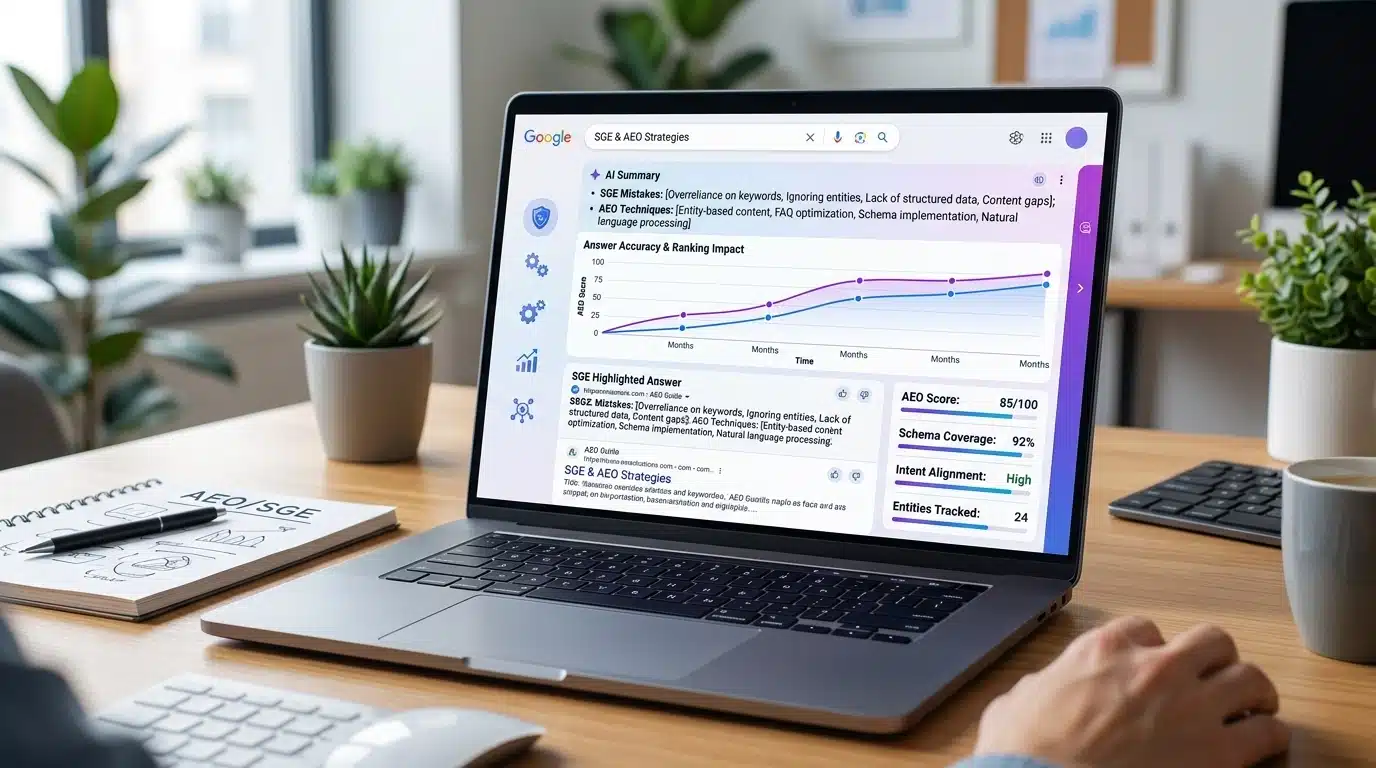
The search landscape has shifted beneath our feet.
Gone are the days when simply ranking #1 on a static list of blue links was the ultimate goal. In 2026, Google’s Search Generative Experience (SGE) has redefined how users interact with information. If you are still clinging to 2020-era SEO tactics, you’re not just standing still: you’re falling behind.
To thrive in this new era, you must pivot toward Answer Engine Optimization techniques for Google SGE. This isn’t just a buzzword; it’s a fundamental shift in how we “feed” information to AI-driven search engines. At Celestial Digital Services, we’ve seen countless small business owners struggle because they are treating SGE like a traditional search engine.
Stop guessing. It’s time to Master the transition. Here are the seven most common mistakes businesses make with Google SGE and the high-impact AEO techniques you should use instead to Unleash your brand’s visibility.
1. Mistake: Obsessing Over Exact-Match Keywords
For decades, SEO was a game of “find the keyword, use the keyword.” If you’re still stuffing your headers with “best pizza NYC” in hopes of catching the AI’s eye, you’re missing the point. SGE doesn’t just read words; it understands intent.
The AEO Solution: Optimize for Semantic Intent and Entity Relationships
Instead of focusing on isolated keywords, Transform your strategy to focus on topics and entities. Google’s LLMs (Large Language Models) look for the relationship between concepts.
- Actionable Step: Use natural language that mimics how people actually speak. If you’re selling a service, describe the problems it solves and the context in which it’s used.
- Pro Tip: Incorporate “People Also Ask” themes directly into your content. This helps the AI identify your page as a comprehensive source for the “Answer” it’s trying to generate.
2. Mistake: Publishing “Thin” or Generic Content
AI can summarize generic information faster and better than you can. If your blog post looks like a Wikipedia entry or a basic “Top 5 Tips” list without any unique flavor, Google SGE will likely scrape your data, summarize it, and give the user no reason to click through to your site.
The AEO Solution: Double Down on EEAT (Experience, Expertise, Authoritativeness, and Trustworthiness)
To Unlock a spot in the SGE “snapshot” or the carousel of sources, your content must provide something an AI cannot easily replicate: First-hand experience.
- Actionable Step: Include case studies, original data, and personal anecdotes. Use phrases like “In my 10 years of experience…” or “Our testing showed that…”
- Benefit: This builds credibility with both the AI and the human reader, ensuring that when Google cites a source, it’s yours.

3. Mistake: Ignoring Conversational Long-Tail Queries
Traditional search queries are often fragmented (e.g., “AEO techniques”). SGE queries are increasingly conversational and interrogative (e.g., “What are the best Answer Engine Optimization techniques for a small e-commerce business in 2026?”).
The AEO Solution: Structure Content as Direct Answers
One of the most effective Answer Engine Optimization techniques for Google SGE is the “Question-Answer” format.
- Actionable Step: Use H2 or H3 headers that are framed as questions. Immediately follow the header with a concise, 2-3 sentence direct answer.
- Why it works: This structure makes it incredibly easy for Google’s AI to identify your content as the perfect “snippet” to populate an AI Overview.
4. Mistake: Neglecting Technical Schema Markup
Many business owners think technical SEO is dead because AI is “smart” enough to read anything. That is a dangerous misconception. While AI is smart, it still relies on structured data to categorize information accurately and quickly.
The AEO Solution: Implement Advanced Schema for LLMs
You need to make your data “machine-readable.”
- Actionable Step: Ensure you are using
FAQSchema,HowToSchema, andProductSchemacorrectly. - The Bottom Line: By providing a clear roadmap of your data, you reduce the “friction” for the AI, making it more likely to prioritize your site as a trusted source. You can learn more about these technical shifts in our Mastering Answer Engine Optimization (AEO) Techniques course.
5. Mistake: Treating Your Website Like a Silo
In the age of SGE, Google doesn’t just look at your website. It looks at your entire digital footprint to verify your authority. If your LinkedIn is empty, your Google Business Profile is outdated, and you have no social proof, the AI may deem you “unreliable.”
The AEO Solution: Build a Holistic Digital Ecosystem
Elevate your brand by ensuring consistency across all platforms.
- Actionable Step: Optimize your Google Business Profile and maintain an active presence on platforms like LinkedIn and YouTube.
- Insight: SGE often pulls from multiple sources to create a “brand overview.” If your social media presence reflects the same expertise as your blog, the AI’s “trust score” for your brand skyrockets.

6. Mistake: Forgetting the “Human” in the Loop
It’s easy to get caught up in optimizing for robots, but remember: the goal of SGE is still to serve a human user. If your content is so structured and technical that it loses its soul, your bounce rate will kill your rankings.
The AEO Solution: Focus on Radical Usefulness
Your content should be a “one-stop shop” for the user’s problem.
- Actionable Step: Instead of just answering a question, provide the “Next Best Action.” If someone asks “How to use AI for SEO,” don’t just give a list: give them a downloadable checklist or a link to a proven SEO Mastery guide.
- Result: This keeps users engaged and signals to Google that your site provides high value beyond just a quick answer.
7. Mistake: Failing to Monitor AI Overviews for Your Brand
Are you tracking how Google’s AI describes your business? Many owners never check. If SGE is hallucinating facts about your pricing or services, you are losing money every single day.
The AEO Solution: Proactive Brand Sentiment Management
You must actively monitor the AI’s output for your brand-related queries.
- Actionable Step: Regularly search for your business name and key services in SGE. If the information is wrong, update your “About Us” page, your schema, and your external profiles to provide the correct “source of truth.”
- Empowerment: You have the power to influence the AI’s narrative by providing clear, consistent, and factual data across the web.
FAQ: Mastering Answer Engine Optimization (AEO)
Q: Is AEO different from traditional SEO?
A: Yes. While SEO focuses on ranking in search engines, AEO focuses on providing the direct “Answer” that AI models (like Google SGE or ChatGPT) use to respond to users. It’s more about being the source of the answer rather than just a link on a page.
Q: Do I need to be a coder to use these AEO techniques?
A: Not at all! Most AEO strategies involve how you write your content and how you structure your ideas. While some technical schema is involved, tools and courses (like ours!) make it accessible for everyone.
Q: How long does it take to see results from AEO?
A: AI models iterate quickly. If you update your content to be more “answer-friendly,” you can often see changes in AI Overviews within weeks, as opposed to the months it sometimes takes for traditional organic rankings to shift.
Conclusion: Start Your Journey to Search Mastery
The transition to AI-driven search isn’t a threat: it’s an opportunity for those willing to adapt. By moving away from outdated tactics and embracing Answer Engine Optimization techniques for Google SGE, you can Transform your small business into an authoritative powerhouse that the AI can’t help but recommend.
Don’t let your competitors get the “last word” in the AI snapshot. Enroll today in our comprehensive digital courses and learn how to dominate search engines, master AI productivity, and grow your revenue in this brave new digital world.