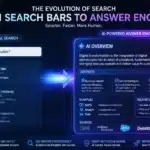
The search landscape just underwent a seismic shift. If you’ve searched for anything on Google lately, you’ve seen it: a large, colorful box at the top of the results that summarizes the answer to your question before you even click a single link. These are Google AI Overviews, and they are fundamentally changing how people interact with the web.
For years, the goal was simple: rank on Page 1. But in 2026, being “on Page 1” isn’t enough if an AI is summarizing your content without giving you credit. Mastering Answer Engine Optimization (AEO) is no longer optional, it’s the new frontier of SEO for small business owners. To stay relevant, you must ensure your brand is the one the AI chooses to cite as its source of truth.
In this guide, we will unlock the strategies you need to transform your content from a standard blog post into a high-authority citation source for Google’s AI.
What is Answer Engine Optimization (AEO)?
Before we dive into the “how,” let’s define the “what.” Answer Engine Optimization (AEO) is the practice of optimizing your digital content to be the definitive answer for user queries, specifically for AI-driven platforms like Google’s AI Overviews, ChatGPT, and Perplexity.
While traditional SEO focuses on keywords and backlinks to rank a page, AEO focuses on context, structure, and directness. You aren’t just trying to get a click; you are trying to provide the specific “nugget” of information that the AI wants to lift and present to the user.

Alt text: A well-organized digital strategy workspace featuring a laptop with analytics and SEO reports, representing modern business growth planning.
Why AI Citations are the New “Position Zero”
In the past, “Position Zero” was the featured snippet. Today, AI Citations are even more powerful. When Google’s AI generates a summary, it includes small, clickable cards or links, these are the citations.
For SEO for small business owners, appearing in these citations provides:
- Instant Authority: If Google’s AI trusts your answer enough to quote it, your brand becomes the immediate expert in the user’s eyes.
- Highly Targeted Traffic: Users who click through from an AI citation are often further down the funnel, looking for the “how” or “why” behind the “what.”
- Voice Search Dominance: Most AI-driven answers are the same ones used for voice search on devices like Google Home or smartphones.
Step 1: The “Answer-First” Content Strategy
Google’s AI is a “skimmer.” It wants to find the answer as quickly as possible. To get cited, you need to unleash a structure known as the Inverted Pyramid.
The 60-Word Rule
At the beginning of your article or under a specific H2 heading, provide a direct, concise answer to the primary question in 40 to 70 words. This is your “Answer Block.”
Example:
If your heading is “What is the best SEO strategy for small businesses in 2026?”, your first sentence should be: “The best SEO strategy for small businesses in 2026 is Answer Engine Optimization (AEO), which focuses on providing direct, structured answers to conversational queries to earn citations in AI-driven search results.”
By putting the answer first, you make it incredibly easy for the AI to extract and quote your content.
Step 2: Use AI-Friendly Formatting
If your content is a wall of text, the AI will ignore it. You need to transform your layout into something scannable.
- Bullet Points and Numbered Lists: AI Overviews love lists. Use them for “how-to” steps, checklists, or “best of” features.
- Comparison Tables: If you are comparing two products or services, use an HTML table. AI models are exceptionally good at reading and summarizing tabular data.
- Question-Based Headings: Use H2 and H3 tags that mirror exactly what users ask. Instead of “Our Services,” use “What Services Does Celestial Digital Services Offer?”

Alt text: Professionals in a modern office collaborating on AI-driven data analytics and business strategy.
Step 3: Build Radical Authority (E-E-A-T)
Google’s AI doesn’t just want an answer; it wants a reliable answer. This is where E-E-A-T (Experience, Expertise, Authoritativeness, and Trustworthiness) comes in.
To boost your business authority:
- Cite Your Sources: Don’t just make claims. Link to (.gov), (.edu), or high-authority industry reports.
- Original Data: If you have conducted a survey or have internal data, share it! AI loves citing original statistics.
- Author Bios: Ensure every blog post has a clear author bio that links to a detailed “About” page or LinkedIn profile. Prove that a real human expert wrote the content.
Step 4: Technical Signals and Schema
While high-quality writing is key, technical signals act as the “map” for the AI. Mastering Answer Engine Optimization (AEO) Techniques involves more than just words; it requires clean code.
- Article Schema: Tell Google exactly what the page is about.
- FAQ Schema: This is a powerhouse for AEO. By including FAQ schema, you are essentially handing Google a “Question and Answer” sheet on a silver platter.
- Breadcrumbs: These help the AI understand where your page sits within your site’s hierarchy.
Master the Future of Search Today
If this feels like a lot to take in, don’t worry. We’ve built a comprehensive resource to help you navigate this transition. Our course, Mastering Answer Engine Optimization (AEO) Techniques, is designed specifically for entrepreneurs who want to dominate the AI era.
Inside, you’ll find 32 lessons covering:
- Transitioning from traditional SEO to AEO.
- Crafting “Answer-Centric” content that wins citations.
- Hands-on workshops for structured data implementation.
Enroll today and start your journey toward becoming the definitive answer in your industry.
Measuring Your Success: AI Citation Tracking
You can’t improve what you don’t track. Unlike traditional SEO, where you just check your “rank,” AEO requires you to look at:
- Citation Share: How often is your site cited in the AI Overview for your target keywords?
- Impression Volume: Are you appearing in the summary even if the user doesn’t click? (This still builds brand awareness!)
- Conversational Keywords: Monitor how users are “talking” to search engines and adapt your headers accordingly.

Alt text: A sleek laptop showing a digital marketing analytics dashboard, representing the monitoring of SEO and AEO performance.
Final Thoughts: The Early Adopter Advantage
The “democratization” of digital skills means that small businesses now have the same tools as giant corporations. By embracing AEO and optimizing for AI Overviews now, you are positioning your business as a leader before the competition even realizes the rules have changed.
Unlock your potential. Transform your content. Master the answer.
Frequently Asked Questions
What is the difference between SEO and AEO?
Traditional SEO focuses on optimizing websites to rank in search engine results pages (SERPs) primarily through keywords and links. AEO (Answer Engine Optimization) is a subset of SEO that specifically focuses on structuring content to provide direct, concise answers that AI search engines can easily summarize and cite.
Does AEO replace SEO for small business owners?
No, it complements it. Traditional SEO is still vital for driving organic traffic through “blue links,” but AEO is becoming the primary way to win visibility in the increasingly prominent AI-generated summaries at the top of the search page.
How long does it take to see results from AEO?
AEO can often yield results faster than traditional backlink-building. If you update an existing high-quality page with an “Answer Block” and proper schema, Google’s AI may begin citing it within a few days to weeks after recrawling the site.
Do I need to be a developer to implement AEO?
Not at all. Most AEO strategies involve how you write your content (using clear headings and direct answers) and using simple plugins or tools to add “Schema” data to your website.
Is there a specific word count for AEO-focused articles?
While depth is important for authority, Google’s AI often cites pages in the 1,000 to 1,500-word range. The most important factor is the clarity of your headings and the directness of your answers, rather than just the total length.