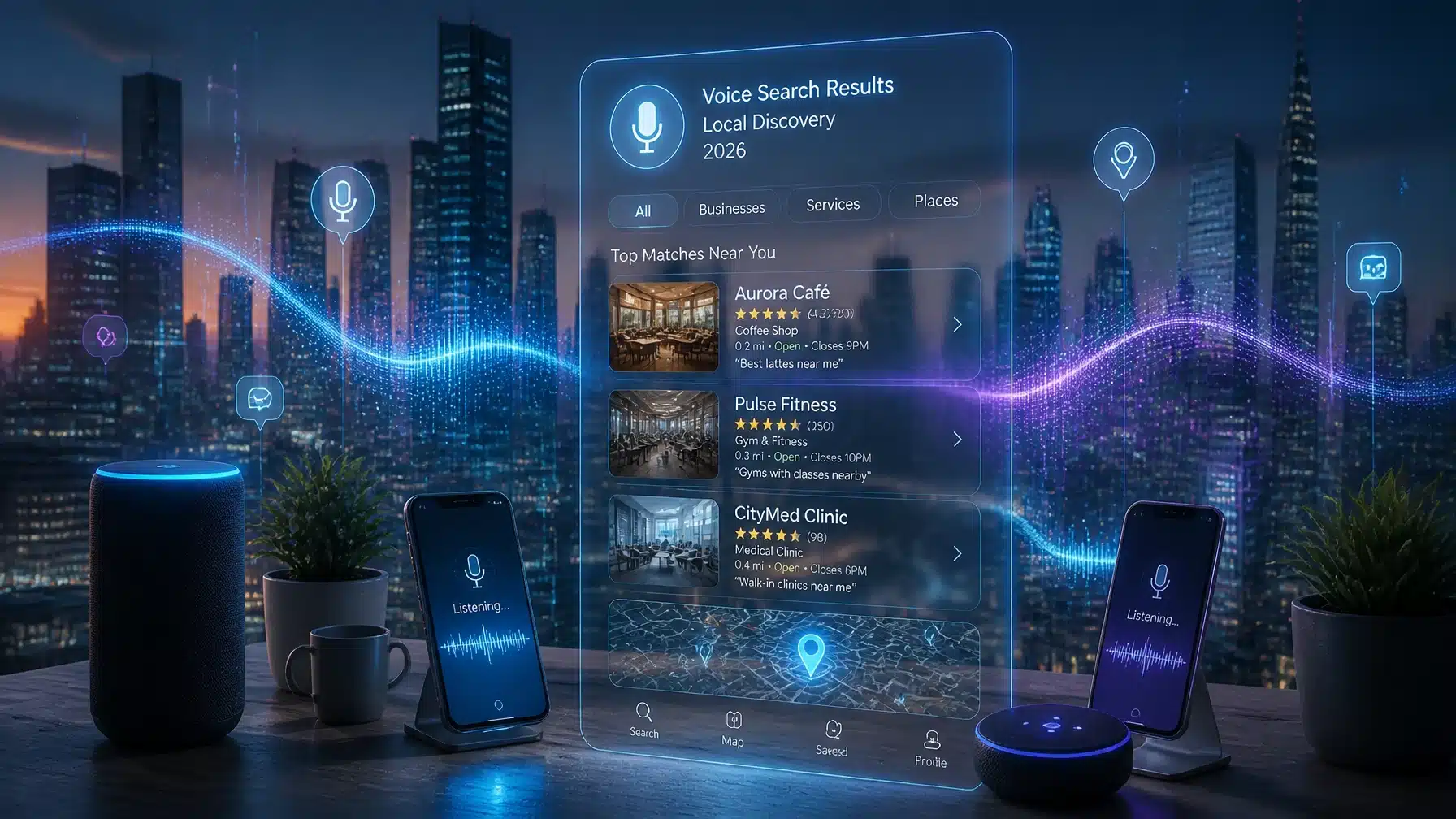
The year is 2026, and the digital landscape has undergone a seismic shift. If you are still thinking about SEO as just a list of keywords on a white screen, you are living in the past. Today, search isn’t just something we type; it’s something we do, often while driving, cooking, or walking down a busy street.
The question isn’t “Does voice search matter?” but rather “Can your business afford to be invisible in the age of AI discovery?”
Voice search has evolved from a novelty into the primary interface for local intent. With the integration of advanced Large Language Models (LLMs) into every smartphone, car, and smart home device, the way customers find “the best coffee shop near me” or “emergency plumber open now” has fundamentally changed. We are no longer just optimizing for Google; we are optimizing for “Answer Engines.”
In this ultimate guide, we will explore why voice search optimization for local marketing is your ticket to dominating your market and how you can Master the tools of tomorrow, today.
The Convergence of Voice and AI Discovery
In 2026, voice search and AI are two sides of the same coin. When a user asks their AI assistant a question, the assistant doesn’t just read a list of blue links. It curates a single, authoritative answer. This process, AI discovery, relies on how well your business data is structured and how clearly you answer the user’s intent.
Why It Matters for Local Businesses
Local search is the heart of voice queries. According to recent data, over 75% of voice searches are looking for local information. Whether it’s hours of operation, service availability, or physical location, your digital presence must be “speakable.”
If you aren’t visible in these AI-curated summaries, you simply don’t exist to a massive segment of your potential customers. Unlock your potential by shifting your focus from traditional rankings to becoming the “chosen answer.”
Local SEO Tip #1: Dominate with Your Google Business Profile
Your Google Business Profile (GBP) is the “Source of Truth” for AI assistants. When Google’s Gemini or Apple’s Siri looks for a local solution, they check the most verified, active, and complete data source first.

Alt-text: A modern workspace with digital dashboards, representing the data-driven approach needed for Google Business Profile optimization.
To Unleash the full power of your GBP, you must go beyond the basics:
- Hyper-Specific Categories: Don’t just list “Restaurant.” Use “Organic Vegan Bistro in Downtown Seattle.”
- Attributes Matter: AI discovery thrives on details. Tag your business with “Outdoor seating,” “Free Wi-Fi,” or “Wheelchair accessible.”
- The Q&A Goldmine: Seed your own Q&A section with conversational questions customers actually ask via voice. For example: “Do you offer emergency plumbing on Sundays in Springfield?”
Pro Tip: If you haven’t mastered this yet, our Google Business Profiles: A Complete Guide will walk you through every step to ensure you are the first choice for local AI engines.
Local SEO Tip #2: Craft Conversational, Question-Based Content
Voice queries are long-tail and natural. People don’t bark “Plumber NYC” at their phones; they ask, “Hey Siri, who is the best-rated plumber near me that can fix a leak tonight?”
To capture this traffic, your website content must mirror these human conversations.
- Build FAQ Clusters: Create dedicated pages that answer the “Who, What, Where, When, and Why” of your business.
- Speak the Language of Your Customer: Use local landmarks and colloquialisms. Instead of “Central Florida,” use “The Greater Orlando Area near Lake Eola.” This helps AI associate your business with specific geographic markers.
By focusing on voice search optimization for local marketing, you are essentially training AI agents to understand exactly what you do and where you do it.
Local SEO Tip #3: Master Answer Engine Optimization (AEO)
We are moving past Search Engine Optimization into the era of Answer Engine Optimization (AEO). This involves structuring your information so that AI models can easily digest and relay it.

Alt-text: A 3D visualization of interconnected data nodes feeding into an AI brain, symbolizing the power of Answer Engine Optimization.
AEO Strategies Include:
- Schema Markup: Use
LocalBusiness,FAQPage, andProductschema. This is the “hidden language” that tells AI exactly what your prices, hours, and services are. - Snippet-Ready Answers: Write your primary answers in 1–2 punchy sentences (under 40 words). This makes it easy for a voice assistant to read your answer aloud.
- E-E-A-T (Experience, Expertise, Authoritativeness, Trust): AI discovery favors businesses with high trust signals. Ensure your “About Us” page highlights your local history and professional certifications.
Ready to dive deeper? Explore our course on Mastering Answer Engine Optimization (AEO) Techniques to stay ahead of the curve.
Local SEO Tip #4: The Power of Reviews and Social Proof
In 2026, reviews aren’t just for humans; they are a critical ranking signal for AI. AI assistants often summarize reviews to provide a “verdict” on your business.
“People like this place for its fast service and friendly staff, though some mention parking can be tricky.”

Alt-text: A diverse business team collaborating on digital strategy, emphasizing the importance of managing local reputation and reviews.
To Transform your reputation into a ranking factor:
- Encourage Keyword-Rich Reviews: Ask happy customers to mention the specific service and location. “Best HVAC repair in Austin!” is a massive signal for AI discovery.
- Respond to Everything: Use natural, keyword-rich language in your responses. “Thank you, Sarah! We love being the go-to emergency electrician for the Northside community.”
Local SEO Tip #5: Technical Performance is Non-Negotiable
Voice search often happens on the go, using mobile data. If your site is slow, you are out.
- Mobile-First is Mandatory: Ensure your site is fully responsive.
- Core Web Vitals: Google and other AI engines prioritize fast-loading, secure (HTTPS) sites.
- Location Signals: Ensure your NAP (Name, Address, Phone) is consistent across every single directory, from Yelp to Apple Maps. Inconsistent data is the fastest way to confuse an AI assistant.
How Celestial Digital Services Can Help
At Celestial Digital Services, we specialize in providing the tools you need for a seamless transformation into the AI-driven future. Whether you are a small business owner or a marketing professional, our resources are designed for immediate impact.
- Upskill Your Team: Learn how to integrate AI into your workflow with our AI Strategies for Boosting Revenue.
- Dominate Social: Voice search isn’t just for Google. It’s happening on YouTube and TikTok too. Master these platforms with our YouTube Content Creation with AI course.
Conclusion: Start Your Journey Today
Does voice search matter in 2026? Absolutely. It is the gateway to AI discovery. By implementing these local SEO tips, you aren’t just keeping up; you are positioning your business as a leader in your community.
The transition from traditional search to conversational AI doesn’t have to be overwhelming. With the right strategy and a commitment to practical, data-driven optimization, you can ensure that when your customers ask for help, it’s your voice they hear.
Enroll today and start your journey toward digital mastery. Check out our full list of courses and take the first step toward future-proofing your business.

Alt-text: A modern classroom setting representing the journey of digital learning and mastering AI-driven marketing strategies.
Frequently Asked Questions (FAQ)
What is the difference between SEO and AEO?
SEO (Search Engine Optimization) focuses on ranking in traditional search results. AEO (Answer Engine Optimization) focuses on being the direct answer provided by AI assistants like Gemini, ChatGPT, and Siri. AEO is a subset of SEO that is critical for voice search optimization for local marketing.
Does voice search only apply to smartphones?
No. In 2026, voice search is integrated into smart home devices (Alexa, Google Home), smartwatches, and even modern vehicle dashboards. AI discovery happens across an entire ecosystem of connected devices.
How often should I update my Google Business Profile?
At a minimum, you should post an update once a week and respond to new reviews within 24–48 hours. Frequent activity tells AI engines that your business is active and reliable.
Is schema markup really necessary for a small local business?
Yes. It is the only way to ensure that AI assistants understand your business’s technical details (like exact coordinates and specific service prices) without error. It is a fundamental pillar of AI discovery.
Can I get a refund if the courses aren’t for me?
We maintain a professional and firm business standard regarding our digital products. Please refer to our official terms and conditions for our current refund policies before purchasing.