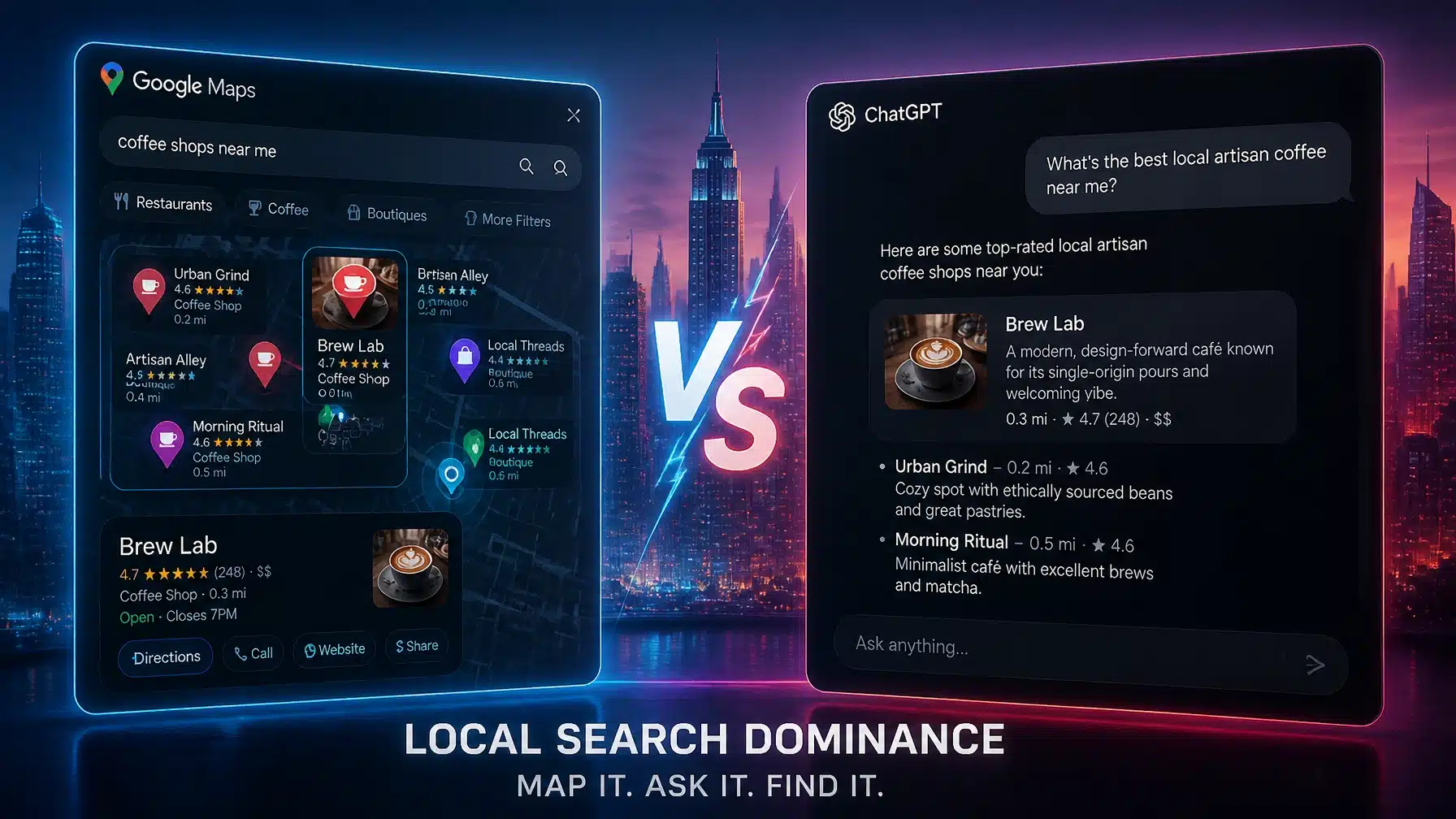
The way we find “the best espresso near me” has changed forever. It’s no longer just about typing keywords into a search bar; it’s about a conversation. As we move deeper into 2026, the battle for local business discovery is being fought on two main fronts: the established titan, Google Maps, and the conversational disruptor, ChatGPT.
For entrepreneurs, this shift presents a massive opportunity. If you can Master the nuances of how these platforms deliver information, you can Unlock a steady stream of high-intent customers who are ready to buy. But where should you put your energy? Should you double down on SEO for small business owners on Google, or is it time to pivot toward voice search optimization for local marketing on AI platforms?
In this ultimate guide, we’ll dive into the head-to-head comparison and show you exactly how to Transform your local presence to win on both.
The Legacy King: Why Google Maps Still Rules the Streets
Google Maps isn’t just a map anymore; it’s a massive local commerce engine. With over 1.5 billion destination visits monthly, it remains the gold standard for navigational intent. When someone opens Google Maps, they usually have a credit card in their pocket and are ready to drive to your door.
The Power of the Google Business Profile
At the heart of this ecosystem is your Google Business Profile (GBP). This is the single most important asset for any local business. In 2026, Google’s AI (Gemini) pulls directly from your GBP data to answer local queries across Search, Maps, and even voice-activated devices.
Key Strengths of Google Maps:
- Visual Trust: Photos of your shop, products, and real-time customer reviews are front and center.
- Proximity Precision: It knows exactly where the user is and prioritizes the closest options.
- Transactional Tools: Users can call, get directions, or book an appointment with a single tap.
If you haven’t fully optimized your profile yet, you are leaving money on the table. Unleash your business’s potential by checking out our Google Business Profiles: A Complete Guide.

Effective local marketing starts with a robust digital foundation.
The Conversational Disruptor: How ChatGPT is Changing Discovery
While Google Maps is great for “where,” ChatGPT is becoming the king of “why” and “how.”
Imagine a user asking: “I’m planning a surprise 10th anniversary dinner for my wife. She loves hidden gem Italian spots with a quiet atmosphere and a great wine list in downtown Seattle. What do you recommend?”
Google Maps might give you a list of five-star Italian restaurants. ChatGPT, however, will synthesize reviews, articles, and menu data to explain why a specific bistro is the perfect match for that specific anniversary vibe.
How AI Search Finds You
ChatGPT doesn’t just look at keywords. It looks at context. It pulls information from the Bing index, major directories like Yelp and TripAdvisor, and your own website content. This is where Answer Engine Optimization (AEO) comes into play. You aren’t just ranking for a search; you are being selected as the “answer” to a complex human need.
Key Strengths of ChatGPT:
- Contextual Understanding: It handles long, complex, and highly specific queries better than traditional search.
- Synthesized Reviews: It can summarize hundreds of reviews into a few bullet points, giving the user a quick “vibe check.”
- Personalization: It learns from the user’s previous preferences to make better recommendations.
To stay ahead of this curve, you need to Master the art of being “AI-ready.” Our course on Mastering Answer Engine Optimization (AEO) Techniques is designed specifically for this new frontier.

AI is no longer the future, it’s the present tool for business growth.
Head-to-Head: Google Maps vs. ChatGPT
| Feature | Google Maps | ChatGPT / AI Search |
|---|---|---|
| Primary Intent | Navigational & Transactional | Research & Recommendation |
| Best For… | “Find a plumber near me right now.” | “Help me find a quiet cafe for a 3-hour work session.” |
| Core Data Source | Google Business Profile | Web Index, Directories, Training Data |
| User Experience | Map-centric, visual, fast | Chat-centric, descriptive, detailed |
| Ranking Factors | Proximity, Reviews, GBP Accuracy | Authority, Citations, Natural Language |
SEO for Small Business Owners: Winning the “Near Me” Game
In 2026, SEO for small business owners is less about technical wizardry and more about data accuracy and authority. If your business information is inconsistent across the web, AI models will flag you as “unreliable” and stop recommending you.
To Unlock your visibility, focus on these three pillars:
- NAP Consistency: Ensure your Name, Address, and Phone number are identical across Google, Bing, Yelp, Facebook, and your own website.
- Keyword-Rich Reviews: Don’t just ask for five stars; ask customers to mention specific services. A review that says “The vegan cupcakes were the best I’ve had in Chicago” helps you rank for “vegan cupcakes” far better than a simple “Great place!”
- Local Schema Markup: Use “LocalBusiness” schema on your website. This is a snippet of code that tells both Google and AI search engines exactly what you do, where you are, and what your hours are in a language they can’t misinterpret.

Data-driven SEO is the backbone of modern business growth.
The Next Frontier: Voice Search Optimization for Local Marketing
With the rise of smart glasses, AI pins, and advanced car assistants, voice search optimization for local marketing is no longer optional. People talk to AI differently than they type into a box.
When people speak, they use full sentences. They ask questions. They use natural, conversational language. If your content is too stiff or focused solely on “short-tail” keywords, you’ll miss the voice search revolution.
How to Optimize for Voice:
- Build an FAQ Page: Phrase your headers as questions (e.g., “What is the best way to get to our downtown boutique?”).
- Focus on Conversational GBP Descriptions: Write your business description as if you were introducing yourself to a new neighbor.
- Target Long-Tail Keywords: Instead of “Seattle Yoga,” target “Where can I find a beginner yoga class in Seattle on Sunday mornings?”

Voice search is becoming the primary way users interact with local businesses on the go.
Practical Steps to Elevate Your Business Today
You don’t have to choose between Google Maps and ChatGPT. You need to Transform your strategy to accommodate both.
- Claim Your Bing Places Listing: Since ChatGPT uses the Bing index, ensuring your business is verified on Bing is a quick win for AI discovery.
- Audit Your Content for E-E-A-T: Experience, Expertise, Authoritativeness, and Trustworthiness. AI search engines favor businesses that show they are experts in their local niche.
- Leverage AI for Productivity: Use AI tools to help you respond to reviews faster and generate local-focused social media content. Learn how to do this effectively with our Harnessing AI to Boost Small Business Profits course.
Frequently Asked Questions (FAQ)
Q: Do I need to pay to appear in ChatGPT results?
A: No. Like traditional organic search, you cannot pay for placement in ChatGPT’s organic recommendations. You “earn” your way in through authority, citations, and high-quality content.
Q: Is Google Business Profile still relevant with all these AI tools?
A: More than ever! Google Business Profile is the primary data source for Google Maps, Gemini, and several other AI platforms. It is the “source of truth” for your local identity.
Q: How often should I update my local SEO strategy?
A: Local search is dynamic. We recommend a monthly “check-up” to ensure your hours are correct, your photos are fresh, and you are responding to all new reviews.
Conclusion: Democratizing Your Digital Presence
The “democratization” of search means that a small, local boutique can now compete with a national chain by being more helpful, more contextual, and more “human” in its digital presence. Whether a customer is scrolling through Google Maps or chatting with an AI assistant, your goal is the same: to be the best answer to their problem.
Don’t let your competitors Master these tools before you do. The transition to AI-integrated search is a seamless transformation if you have the right guide.
Enroll in our Digital Courses today and start your journey to local search dominance.

Collaborate with the right tools to ensure your business stays ahead of the curve.