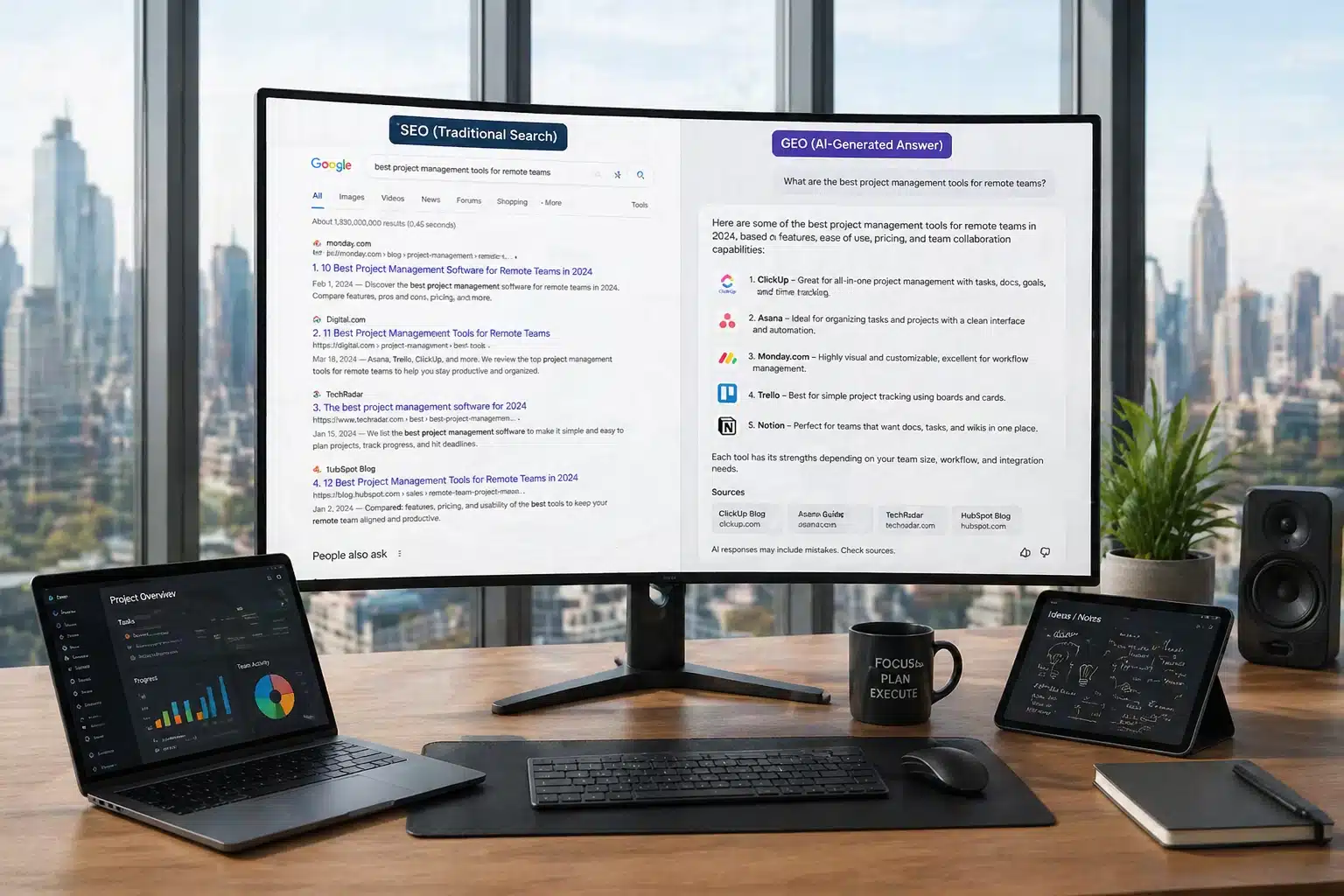
The digital marketing landscape is shifting beneath our feet. For years, the gold standard for getting noticed online was Search Engine Optimization (SEO). You’d pick your keywords, build your backlinks, and hope to land on page one of Google. But as we move deeper into 2026, a new player has entered the arena: Generative Engine Optimization (GEO).
If you’re a small business owner, you might be wondering: “Do I really need to learn another acronym?” The short answer is yes. But the good news is that understanding the difference between GEO and SEO doesn’t just save you from becoming obsolete, it gives you a massive competitive advantage.
In this guide, we’re going to break down exactly what these two strategies are, how they differ, and most importantly, which one you should prioritize to master your online presence and unleash your business’s full potential.
Understanding the Basics: SEO vs. GEO
Before we dive into the “which is better” debate, let’s define the terms of the game.
What is SEO?
SEO for small business owners has always been about visibility. It is the process of optimizing your website so that search engines like Google can crawl, index, and rank your pages. When a potential customer types “best plumber in Austin” into a search bar, SEO is what helps your business appear in those “blue links” on the first page.
The goal of SEO is to drive clicks. You want someone to see your link, click it, and land on your website where you can convert them into a customer.
What is GEO?
Generative Engine Optimization (GEO) is the evolution of search. It focuses on optimizing your content to be cited and recommended by AI-powered “answer engines” like ChatGPT, Perplexity, and Google’s Gemini (formerly Bard).
Unlike SEO, which aims for a high ranking in a list of links, GEO aims to be the source of truth that the AI uses to construct its answer. When a user asks an AI, “How do I choose the best digital marketing course for my team?”, GEO ensures the AI mentions your business or quotes your expert advice as the answer.

The Core Differences: Why Your Strategy Must Change
The move from “Search” to “Generative” isn’t just a technical tweak; it’s a fundamental change in how users consume information.
1. Clicks vs. Citations
In the SEO world, success is measured by organic traffic. In the GEO world, success is measured by citations. While AI overviews often provide links to their sources, the click-through rates are significantly lower than traditional search. However, being the cited authority builds an incredible amount of brand trust. If ChatGPT tells a user that your business is the expert on AI strategies, that carries more weight than just being one of ten links on a page.
2. Keywords vs. Context
SEO relies heavily on keyword density and placement. While this is still important, GEO prioritizes context and clarity. AI engines aren’t looking for a list of keywords; they are looking for comprehensive, accurate answers to specific questions. To win at GEO, your content needs to be structured in a way that an AI can easily digest and “snippetize.”
3. Static vs. Dynamic
Traditional SEO results can stay relatively stable for weeks or months. GEO results are dynamic and often based on the most recent, high-authority information available. This means fresh content and “live” data points (like current pricing or recent reviews) are more critical than ever.
Which One Is Better For Your Small Business?
Now for the million-dollar question: Where should you put your time and money?
The Case for SEO
SEO isn’t dead. In fact, for local businesses, it’s still the powerhouse. If you are a local service provider (like a locksmith, a lawyer, or a bakery), people are still going to use Google Maps and traditional search for “near me” queries. SEO for small business owners remains the most reliable way to capture high-intent traffic that is ready to buy now.
- Pros: High click-through rates, established metrics, great for local intent.
- Cons: Extremely competitive, takes time to see results, prone to algorithm updates.
The Case for GEO
GEO is the future of research and complex decision-making. if you sell digital products, consulting services, or B2B solutions, GEO is where you will win. Users are increasingly turning to AI to compare products and get recommendations. If you aren’t optimized for GEO, you simply won’t exist in those AI-driven conversations.
- Pros: Less crowded than traditional SEO (for now), builds high authority, reaches users in the “research” phase.
- Cons: Harder to track direct ROI, lower click-through rates, requires high-quality “expert” content.

How to Win at Both: A Dual Strategy
You don’t have to choose. In fact, the most successful small businesses in 2026 are using a hybrid approach. Here is how you can transform your digital strategy:
Step 1: Master the Technical SEO Foundations
You can’t have good GEO without solid SEO. Ensure your site is fast, mobile-friendly, and has a clear site structure. Use schema markup (especially FAQ and Article schemas) to help both Google and AI engines understand what your content is about.
Need a head start? Check out our AI Skills Quickstart to see how modern tools can speed up your technical optimization.
Step 2: Implement AEO (Answer Engine Optimization)
AEO is a subset of GEO. It involves creating content specifically designed to answer questions.
- Use FAQ Sections: Every service page should have an FAQ section that answers common customer pain points.
- Direct Language: Instead of “In this article, we will discuss…”, use “The best way to [Problem] is [Solution].”
- Cite Sources: AI engines love it when you cite external experts, as it proves your own content is well-researched.
To dive deeper into this specific skill, our course Mastering Answer Engine Optimization (AEO) Techniques is the ultimate guide for businesses looking to dominate AI search.
Step 3: Focus on E-E-A-T
Experience, Expertise, Authoritativeness, and Trustworthiness. Google and AI engines alike are prioritizing content written by real experts. Make sure your “About Us” page is robust, link to your LinkedIn profile, and gather as many third-party reviews as possible.

Practical Checklist for Small Business Owners
If you’re ready to unlock the power of modern search, follow this checklist:
- Claim Your Google Business Profile: This is the #1 SEO move for local businesses. Learn how here.
- Audit Your Content for “Answerability”: Look at your top-performing blog posts. Do they clearly answer a question in the first 100 words? If not, rewrite them.
- Use AI to Boost Productivity: Use ChatGPT to help you brainstorm FAQ questions your customers might have.
- Stay Updated on AI Trends: The world of GEO changes weekly. Subscribing to a digital education platform like ours ensures you never fall behind.
Frequently Asked Questions
Is SEO for small business owners still worth the investment?
Absolutely. While AI search is growing, billions of searches still happen every day on traditional Google. SEO provides the foundational traffic that every business needs to survive.
Do I need to be a tech expert to do GEO?
No! GEO is more about how you write and structure your information than it is about coding. If you can write a clear, helpful answer to a customer’s question, you are already doing GEO.
How do I track my GEO performance?
This is still an emerging field, but tools like Perplexity and Google Search Console (which now shows AI Overview data) are starting to provide these insights. Focus on “Brand Mentions” and “Referral Traffic” from AI domains.
Can I use AI to write my SEO and GEO content?
Yes, but with a catch. AI can help you outline and draft, but it needs a human touch to ensure accuracy and “E-E-A-T.” If you want to learn how to do this properly, check out our Become a ChatGPT Pro video tutorials.
The Bottom Line: Adapt or Be Left Behind
The choice between GEO and SEO isn’t an “either/or” scenario: it’s an “and.”
SEO will get you the clicks today, but GEO will ensure you are the authority of tomorrow. By harnessing the power of both, you can create a marketing machine that works while you sleep, bringing in customers from traditional search and AI recommendations alike.
Ready to elevate your digital game? Explore our full range of AI and Digital Marketing Courses and start your journey toward digital mastery today. Whether you want to dominate TikTok Shop or master the latest SEO trends, we have the practical, affordable tools you need to succeed.
Enroll today and start your journey!
Target Keyword: SEO for small business owners
Status: Draft